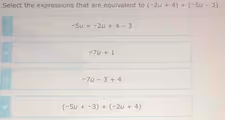
The Correct Answer and Explanation is:
Of the choices provided, the following three expressions are equivalent to (-2u + 4) + (-5u – 3):
- -7u + 1
- -7u – 3 + 4
- (-5u + -3) + (-2u + 4)
Explanation
To find the equivalent expressions, we first need to simplify the original expression, (-2u + 4) + (-5u – 3). The process involves combining like terms, which are terms that have the same variable raised to the same power.
- Remove the Parentheses: Since the two groups of terms are being added, we can remove the parentheses without changing the signs of any terms inside.
(-2u + 4) + (-5u – 3) becomes -2u + 4 – 5u – 3. - Group Like Terms: Next, we rearrange the expression to group the variable terms (those with ‘u’) together and the constant terms (the numbers) together.
(-2u – 5u) + (4 – 3) - Combine Like Terms: Now, we perform the calculations for each group.
- For the variable terms: -2u – 5u = -7u
- For the constant terms: 4 – 3 = 1
Combining these results gives us the fully simplified expression: -7u + 1.
Now, let’s analyze each option:
- -5u = -2u + 4 – 3: This is an equation, not an expression, because of the equals sign. An equation asserts that two sides are equal, while an expression is a mathematical phrase. Therefore, it cannot be equivalent.
- -7u + 1: This matches our simplified result perfectly. It is the most common and direct simplification of the original expression.
- -7u – 3 + 4: This expression is equivalent because it represents a valid intermediate step in our simplification. The ‘u’ terms (-2u and -5u) have been combined to get -7u, but the constant terms (-3 and +4) have not yet been combined. If you simplify this expression further, you get -7u + 1.
- (-5u + -3) + (-2u + 4): This expression is equivalent due to the Commutative Property of Addition, which states that the order in which you add numbers or terms does not change the sum (for example, a + b = b + a). This option simply reverses the order of the two original parenthetical groups, which results in the same final answer.