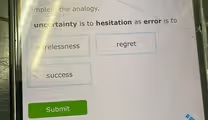
The correct answer is regret.
This analogy is built on a cause and effect relationship. To solve it, we must first understand the connection between the first pair of words, “uncertainty” and “hesitation,” and then apply that same logic to the second pair, “error” and the correct choice.
The relationship between uncertainty and hesitation is one of cause and effect. Uncertainty is a state of being unsure or lacking conviction. This internal feeling or mental state directly leads to hesitation, which is the action of pausing or holding back before acting or speaking. When you are uncertain about what to do, you hesitate. Therefore, uncertainty is the cause, and hesitation is the resulting behavior or effect.
Now, we apply this cause and effect pattern to the second part of the analogy: “error is to _____”. An error is a mistake or a wrong action. We need to identify which of the given options is a direct consequence or effect of committing an error.
Let’s evaluate the choices. “Regret” is a feeling of sadness, repentance, or disappointment over something that has happened or been done. Making an error very commonly leads to a feeling of regret. The error is the cause, and the emotional response of regret is the effect. This relationship perfectly mirrors the “uncertainty leads to hesitation” pattern.
The other options are incorrect because they do not fit this cause and effect structure. “Carelessness” is often a cause of an error, not an effect. A person might make an error because they were careless. This reverses the required relationship. “Success” is the antonym, or opposite, of an error. It has no causal link in the way the analogy requires.
Therefore, “regret” is the logical completion of the analogy because it maintains the consistent relationship where a specific state or event (uncertainty, error) leads to a corresponding action or feeling (hesitation, regret).