The Correct Answer and Explanation is:
Of course. Here is the correct answer and a detailed explanation.
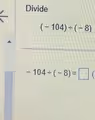
The correct answer is 13.
To solve the problem (-104) ÷ (-8), we need to follow two main steps: first, determine the sign of the result, and second, perform the division of the numbers.
The most important rule to remember here involves dividing integers with signs. When you divide a negative number by another negative number, the result will always be positive. You can think of it as the two negative signs “canceling each other out” to create a positive. This rule is consistent with multiplication, where multiplying two negatives also yields a positive result. So, we already know our final answer will be a positive number.
Now that we have determined the sign, we can focus on the division itself by using the absolute values of the numbers: 104 ÷ 8.
If you don’t know the answer immediately, you can break the problem down into smaller, more manageable steps. A helpful strategy is to find a familiar multiple of 8 that is close to 104. For instance, we know that 8 multiplied by 10 is 80.
Next, we see what is left over from 104 after we account for the 80. We can do this with subtraction: 104 – 80 = 24.
Now, we only need to figure out how many times 8 goes into the remaining 24. We know that 8 × 3 = 24.
Finally, we add the results from our two steps together. We had 10 (from 80 ÷ 8) and 3 (from 24 ÷ 8). Adding these gives us 10 + 3 = 13.
To verify our answer, we can use multiplication. If (-104) ÷ (-8) = 13, then 13 × (-8) should equal -104. A positive number (13) multiplied by a negative number (-8) results in a negative product. Since 13 × 8 is 104, it confirms that 13 × (-8) is indeed -104.