The Correct Answer and Explanation is:
Here are the correct answers and explanations for the questions provided.
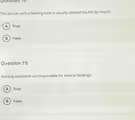
Question 19: The person with a feeding tube is usually allowed to eat by mouth.
Answer: B) False
A person who requires a feeding tube is typically not allowed to eat or drink by mouth. The medical order for this is “NPO,” which stands for the Latin phrase nil per os, meaning “nothing by mouth.” Feeding tubes, such as nasogastric (NG) or gastrostomy (PEG) tubes, are necessary when a person cannot consume food orally in a safe manner or in sufficient quantity.
The most common reason for a feeding tube is dysphagia, or difficulty swallowing, which creates a high risk for aspiration. Aspiration happens when food, liquid, or saliva accidentally enters the airway and lungs, which can lead to a severe and life threatening infection known as aspiration pneumonia. To prevent this dangerous complication, all oral intake is restricted.
While there are rare exceptions where a patient may be allowed small, prescribed amounts of specific consistencies for swallowing therapy under the direct supervision of a speech language pathologist, this is not the usual case. For the vast majority of patients with feeding tubes, the standard and safest practice is to strictly follow the NPO order. Therefore, the statement that they are usually allowed to eat by mouth is false.
Question 19 (duplicate number): Nursing assistants are responsible for enteral feedings.
Answer: B) False
Nursing assistants are not responsible for administering enteral feedings. This task falls outside their scope of practice and is the responsibility of a licensed nurse, such as a Registered Nurse (RN) or Licensed Practical/Vocational Nurse (LPN/LVN).
Enteral feeding is a medical procedure that requires clinical knowledge and technical skill. A licensed nurse is responsible for critical steps like verifying the correct placement of the tube before starting a feeding, flushing the tube to ensure it is clear, administering the formula at the prescribed rate, and programming the feeding pump. Most importantly, the nurse must assess the patient for tolerance to the feeding and monitor for serious complications, including aspiration, abdominal distention, and electrolyte imbalances.
A nursing assistant provides essential supportive care. Their duties may include elevating the head of the patient’s bed to reduce aspiration risk, providing oral hygiene, observing the patient for signs of distress like coughing or vomiting, and immediately reporting any pump alarms or patient concerns to the nurse. However, the ultimate accountability for safely and correctly administering the feeding rests with the licensed nursing staff.