The Correct Answer and Explanation is:
The correct answer is 0.121.
Here is a step-by-step explanation of how to find the solution:
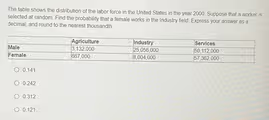
To solve this problem, we need to find the probability that a randomly selected worker is a female who works in the industry field. The wording of the question, “the probability that a female works in the Industry field,” suggests a conditional probability. We are determining the likelihood that a worker is in the industry sector, given that the worker is female.
First, we must determine the total number of female workers in the labor force. To do this, we sum the numbers in the “Female” row of the table.
Total female workers = (Females in Agriculture) + (Females in Industry) + (Females in Services)
Total female workers = 867,000 + 8,004,000 + 57,362,000
Total female workers = 66,233,000
This total represents our sample space because the condition is that the worker is female.
Next, we identify the number of “favorable” outcomes, which is the number of female workers in the industry field. Looking at the table, we find this value at the intersection of the “Female” row and the “Industry” column.
Number of females in industry = 8,004,000
Now, we can calculate the probability by dividing the number of females in industry by the total number of female workers.
Probability = (Number of females in industry) / (Total number of female workers)
Probability = 8,004,000 / 66,233,000
Performing the division gives us:
Probability ≈ 0.120846
The question asks to round the answer to the nearest thousandth, which is the third decimal place. The fourth decimal digit is 8, which is 5 or greater, so we round up the third digit.
Rounded Probability ≈ 0.121
Therefore, the probability that a female worker works in the industry field is approximately 0.121.