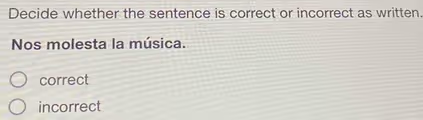
The Correct Answer and Explanation is:
The correct answer is correct.
The sentence “Nos molesta la música” is a grammatically sound and complete sentence in Spanish. Its structure is a common source of confusion for English speakers, but it follows a standard grammatical pattern for verbs that express feelings or psychological states, such as gustar (to like), encantar (to love), interesar (to interest), and molestar (to bother).
To understand why it is correct, we must analyze its components. In this type of construction, the thing that causes the feeling is the grammatical subject of the sentence. Here, the subject is “la música” (the music). The verb must agree in number with this subject. Since “la música” is a singular noun, the verb molestar is correctly conjugated in the third person singular form, which is “molesta”. If the subject were plural, for example, “las canciones” (the songs), the verb would also need to be plural: “Nos molestan las canciones”.
The person or people who experience the feeling are indicated by an indirect object pronoun. In this sentence, “nos” is the indirect object pronoun for “we” or “us”. It signifies that we are the ones being bothered by the music. A literal, though awkward, translation into English would be “The music is bothersome to us.” A more natural translation is simply “The music bothers us” or “We don’t like the music.”
This structure is the reverse of how it is typically expressed in English, where “we” would be the subject of the sentence (“We are bothered by the music”). In Spanish, the focus is on the object causing the annoyance. Because the verb “molesta” correctly agrees with its singular subject “la música” and the indirect object “nos” is used appropriately, the sentence is grammatically correct as written.