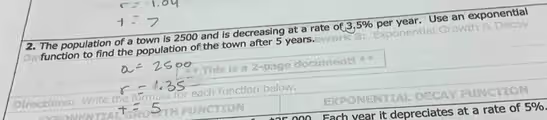
The Correct Answer and Explanation is:
Correct Answer: 2092
This problem requires the use of the exponential decay formula to determine the town’s future population. Since the population is decreasing by a consistent percentage each year, this is a classic case of exponential decay, not linear decay where a fixed number of people would leave annually. The standard formula for exponential decay is y = a(1 – r)^t.
Let’s break down the components of this formula. The variable ‘y’ represents the final amount after the time has passed, which is the population we want to find. The variable ‘a’ is the initial amount, which is the starting population of the town. The variable ‘r’ stands for the rate of decay expressed as a decimal. Finally, ‘t’ represents the number of time periods that have elapsed, in this case, the number of years.
From the problem statement, we can identify the following values. The initial population ‘a’ is 2500. The time period ‘t’ is 5 years. The rate of decrease ‘r’ is 3.5% per year. It is crucial to convert this percentage into a decimal before using it in the formula. To do this, you divide the percentage by 100, so 3.5% becomes 0.035.
Now, we substitute these values into the exponential decay formula:
y = 2500 * (1 – 0.035)^5
First, we solve the expression inside the parentheses, which represents the decay factor. This factor tells us what percentage of the population remains each year.
1 – 0.035 = 0.965
This means that each year, the town’s population is 96.5% of what it was the previous year.
Next, we apply the exponent to this decay factor:
y = 2500 * (0.965)^5
y = 2500 * (0.836755)
Finally, we multiply this result by the initial population to find the final population:
y ≈ 2091.8875
Since population deals with people, the answer cannot be a decimal. We must round to the nearest whole number. The decimal 0.8875 is greater than 0.5, so we round up. Therefore, the population of the town after 5 years will be approximately 2092.