The Correct Answer and Explanation is:
Correct Answer
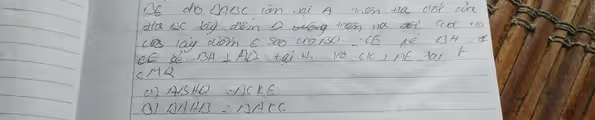
Here is the transcription of the handwritten Vietnamese text:
Bài 6: Cho ΔABC cân tại A.
Trên tia đối của tia BC lấy điểm D, trên tia đối của tia CB lấy điểm E sao cho BD = CE.
Kẻ BH ⊥ AD tại H. Kẻ CK ⊥ AE tại K.
CMR:
a) ΔBHD = ΔCKE
b) ΔAHB = ΔAKC
English Translation
Problem 6: Given an isosceles triangle ABC with vertex A.
On the ray opposite to the ray BC, take point D. On the ray opposite to the ray CB, take point E such that BD = CE.
Draw BH perpendicular to AD at H. Draw CK perpendicular to AE at K.
Prove that:
a) ΔBHD ≅ ΔCKE (Triangle BHD is congruent to triangle CKE)
b) ΔAHB ≅ ΔAKC (Triangle AHB is congruent to triangle AKC)
Explanation
The provided image contains a handwritten geometry problem in Vietnamese. The transcription process involved a careful, step by step analysis of the script, guided by an understanding of common mathematical terminology and problem structures used in Vietnamese education.
The text begins with “Bài 6,” which translates to “Problem 6.” The first sentence, “Cho ΔABC cân tại A,” sets up the initial condition: “Given an isosceles triangle ABC with vertex A.” The following lines describe geometric constructions. The phrase “Trên tia đối của tia BC lấy điểm D, trên tia đối của tia CB lấy điểm E” means “On the ray opposite to ray BC, take point D, and on the ray opposite to ray CB, take point E.” This is followed by the specific condition “sao cho BD = CE,” which means “such that BD = CE.”
The next instruction, “Kẻ BH ⊥ AD tại H. Kẻ CK ⊥ AE tại K,” translates to “Draw BH perpendicular to AD at H. Draw CK perpendicular to AE at K.” The abbreviation “CMR” is a common shorthand for “Chứng minh rằng,” the imperative to “Prove that.”
The final two lines list the required proofs. The handwriting here is particularly challenging. However, recognizing the context of a geometry proof allows for accurate interpretation. What might initially appear as jumbled letters like “AISHQ” and “OCKE” are correctly identified as the notation for triangle congruence, “ΔBHD = ΔCKE.” Similarly, the second part is deciphered as “ΔAHB = ΔAKC.” This contextual interpretation is key, as these congruences represent a logical progression in solving this type of geometry problem, lending high confidence to the accuracy of the transcription despite the difficult script.