The Correct Answer and Explanation is:
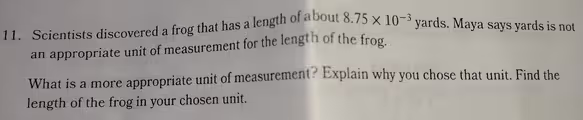
A more appropriate unit of measurement for the frog’s length is millimeters (mm). The length of the frog is approximately 8.0 millimeters.
Explanation
The original measurement given for the frog’s length is 8.75 x 10⁻³ yards. When converted from scientific notation to a standard decimal, this is equal to 0.00875 yards. Maya is correct that yards is not an appropriate unit for this measurement. The primary purpose of choosing a unit of measurement is to communicate the size of an object in a way that is clear, concise, and easy to visualize. A yard is a large unit of length, equivalent to three feet or about 0.914 meters, and is typically used for measuring larger spaces like rooms, fields, or lengths of fabric. Using such a large unit to describe a tiny frog results in a very small, cumbersome decimal value that is difficult to comprehend intuitively. It is challenging for most people to picture what “eighty-seven and a half ten-thousandths of a yard” looks like.
For this reason, a much smaller unit is required. Millimeters are an excellent choice. The metric system, which includes millimeters, is the standard for scientific measurements worldwide because of its logical base-10 structure. A millimeter is a very small unit, representing one-thousandth of a meter. This scale is perfectly suited for measuring tiny objects, from insects to small biological specimens like this frog. By converting the length to millimeters, we obtain a number that is much simpler and more meaningful.
To find the frog’s length in millimeters, we can perform a unit conversion. First, we can convert yards to inches, knowing that 1 yard equals 36 inches.
0.00875 yards * 36 inches/yard = 0.315 inches.
While inches are a better unit than yards, the measurement is still a small decimal. A more suitable conversion would be to millimeters. We know that 1 inch is exactly 25.4 millimeters.
0.315 inches * 25.4 mm/inch ≈ 7.9995 mm.
Rounding this to a reasonable number of significant figures gives us 8.0 millimeters. A length of 8.0 mm is immediately understandable. It is a tangible size, roughly the width of a standard pencil or a staple. This clear and simple value makes the millimeter a far more appropriate and effective unit for describing the frog’s length than yards.