The Correct Answer and Explanation is:
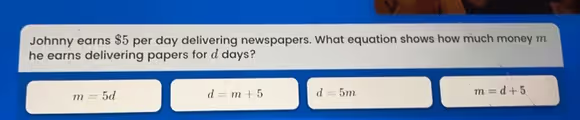
The correct answer is m = 5d.
This problem asks us to create an equation that describes the relationship between the total money Johnny earns, represented by the variable m, and the number of days he works, represented by the variable d.
First, let’s analyze the information given. We know that Johnny earns a fixed amount of $5 for each day he delivers newspapers. The phrase “per day” is a crucial indicator that we need to use multiplication to find the total amount earned over a period. The total earnings are dependent on how many days he works.
Let’s think about this with some examples.
If Johnny works for 1 day, his total earnings would be $5 multiplied by 1, which equals $5.
If he works for 2 days, his earnings would be $5 multiplied by 2, which equals $10.
If he works for 10 days, his earnings would be $5 multiplied by 10, which equals $50.
Following this pattern, to find the total money (m) for any number of days (d), we must multiply the daily rate ($5) by the number of days (d). This relationship is expressed mathematically as:
Total Money = (Money per day) × (Number of days)
Substituting the variables from the problem, we get:
m = 5 × d
In algebra, it is common to write this without the multiplication symbol, so the equation becomes:
m = 5d
Let’s look at why the other options are incorrect.
The equation m = d + 5 suggests that Johnny earns $5 plus the number of days he worked. If he worked for 2 days, this equation would give him $7, which is incorrect.
The equation d = 5m incorrectly reverses the relationship, stating that the number of days is five times the money earned.
The equation d = m + 5 is also incorrect, suggesting the number of days is the money earned plus five.
Therefore, the only equation that accurately represents the situation is m = 5d, as it correctly calculates the total money earned by multiplying the constant daily rate by the number of days worked.