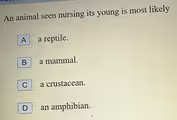
The Correct Answer and Explanation is:
The correct answer is B, a mammal.
The term “nursing” specifically refers to the act of a mother feeding her young with milk produced by her mammary glands. This biological process, also known as lactation, is the single most defining characteristic of the class Mammalia. The very name “mammal” is derived from the Latin word mamma, which means breast or udder. This unique adaptation allows mammalian mothers to provide their offspring with a rich, perfectly tailored source of nutrition during their most vulnerable early stages of life. Milk is a complex liquid containing fats, proteins, carbohydrates, vitamins, and minerals essential for rapid growth and development. Furthermore, it contains antibodies that transfer passive immunity from the mother to the young, helping to protect them from diseases until their own immune systems are more developed.
This trait is universal across the diverse group of mammals, from aquatic species like dolphins and whales to flying mammals like bats and terrestrial mammals like kangaroos and elephants. No other class of animal possesses mammary glands or engages in nursing.
The other options are incorrect for distinct reasons. Reptiles, such as lizards and crocodiles, are primarily egg-laying animals. While some exhibit parental care, like guarding nests or protecting their hatchlings, they do not produce milk. Amphibians, like frogs and salamanders, typically have a larval stage, such as a tadpole, which is aquatic and forages for itself. They lack the anatomy for lactation. Finally, crustaceans, which are invertebrates like crabs and lobsters, reproduce by laying eggs that often hatch into free-swimming larvae. They are biologically incapable of nursing. Therefore, observing an animal nursing its young is a definitive sign that the animal is a mammal.