The Correct Answer and Explanation is:
The correct answer is B. Shear stress.
Shear stress is a type of mechanical stress that occurs when forces act parallel to a surface or plane within a material, causing one part of the material to slide or slip relative to another. A simple way to visualize this is by imagining a deck of cards. If you push the top of the deck horizontally while holding the bottom still, the cards slide over one another. The force you apply creates shear stress between the individual cards.
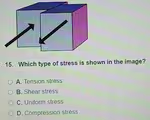
The image provided is a classic illustration of this concept. It shows a block that is being subjected to two opposing forces. One arrow points upward on the left portion of the block, and the other arrow points downward on the right portion. These forces are applied parallel to the vertical face that separates the two parts of the block. This action attempts to shear the block into two pieces along that vertical plane, with the left side moving up and the right side moving down. This sliding motion is the defining characteristic of shear stress.
To understand why the other options are incorrect, it is helpful to define them. Tension stress happens when forces pull an object apart, like stretching a rubber band. The forces would be directed outward, away from each other along the same line. Compression stress is the opposite; it occurs when forces push or squeeze an object together, like crushing a soda can. The forces would be directed inward, toward each other. Uniform stress, often called confining stress, involves pressure being applied equally from all directions, such as the pressure a submarine experiences deep underwater. The specific, directional forces shown in the image clearly represent a shearing action, not pulling, pushing, or uniform pressure.
Real world examples of shear stress are common. The stress on a bolt or rivet holding two metal plates together is primarily shear stress. In geology, the movement along tectonic plate boundaries like the San Andreas Fault is a result of immense shear stress in the Earth’s crust.