The Correct Answer and Explanation is:
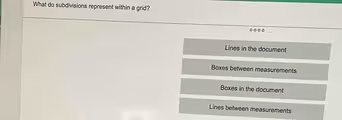
The correct answer is Lines between measurements.
In the context of design, drafting, and digital graphics, a grid is a fundamental tool used to provide structure and order to a layout. It consists of a network of intersecting horizontal and vertical lines that form cells, which are essentially boxes or rectangles. These primary grid lines are typically set at regular, major intervals, serving as the main reference points for alignment and measurement. For example, a grid might be set up with lines every one inch or every 100 pixels.
Subdivisions are secondary, finer lines that are placed within the main cells of the grid. Their specific purpose is to break down the larger measurement units into smaller, more precise increments. If the main grid lines represent inches, the subdivisions might represent quarter inches or eighths of an inch. Similarly, in a digital environment, if the main grid represents 100-pixel intervals, subdivisions could be set for every 10 or 20 pixels.
Therefore, subdivisions are most accurately described as the “lines between measurements.” They exist to provide a more granular level of measurement and guidance, allowing for more precise placement of elements between the major grid lines. While they do form smaller boxes, the subdivisions themselves are the lines that create these spaces. The other options are less accurate; “lines in the document” is too general, and describing them as “boxes” misidentifies the lines for the spaces they enclose. The function of subdivisions is directly tied to refining the measurement system established by the main grid, making “lines between measurements” the most functionally correct description.