The Correct Answer and Explanation is:
Here is the correct solution to the exercise.
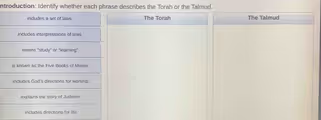
The Torah
- includes a set of laws
- is known as the Five Books of Moses
- includes God’s directions for worship
- explains the story of Judaism
- includes directions for life
The Talmud
- includes interpretations of laws
- means ‘study’ or ‘learning’
Explanation
The exercise requires distinguishing between two of Judaism’s most central texts, the Torah and the Talmud. These two works are deeply interconnected, representing the Written and Oral Law, respectively.
The Torah is the foundational text of Judaism. It is correctly identified as the “Five Books of Moses,” which are Genesis, Exodus, Leviticus, Numbers, and Deuteronomy. This collection “explains the story of Judaism” by narrating the creation of the world, the lives of the patriarchs and matriarchs, the exodus from Egypt, and the receiving of the law at Mount Sinai. As the divine revelation to Moses, the Torah “includes a set of laws,” specifically the 613 commandments (mitzvot) that form the basis of Jewish law. These commandments provide “God’s directions for worship,” detailing rituals and sacrifices, and offer comprehensive “directions for life,” guiding ethical behavior and daily conduct. The Torah is considered the direct word of God and the ultimate source of authority.
The Talmud, on the other hand, is a vast compendium of rabbinic discussions, debates, and interpretations of the Torah’s laws. Its very name reveals its purpose, as “Talmud” is derived from a Hebrew root meaning “to study” or “to learn.” Its primary function is to provide “interpretations of laws.” For centuries, rabbis and scholars analyzed the Torah’s commandments, debating their meaning and application to new situations not explicitly covered in the original text. The Talmud records these extensive discussions on Jewish law, ethics, philosophy, and history, making it the central text of Rabbinic Judaism. In essence, while the Torah provides the fundamental laws, the Talmud is the indispensable guide to understanding and practicing them in the complexities of everyday life.