The Correct Answer and Explanation is:
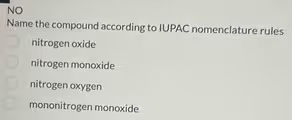
The correct answer is nitrogen monoxide.
The compound with the chemical formula NO is a binary covalent compound, meaning it is formed between two nonmetal elements, in this case, nitrogen (N) and oxygen (O). The International Union of Pure and Applied Chemistry (IUPAC) has a specific set of rules for naming these types of molecules to ensure clarity and avoid ambiguity.
The rules for naming binary covalent compounds are as follows:
- The first element in the formula is named using its full element name. In this case, it is “nitrogen”.
- The second element is named by taking the root of its name and adding the suffix “-ide”. For oxygen, the name becomes “oxide”.
- Greek prefixes (mono-, di-, tri-, tetra-, etc.) are used to indicate the number of atoms of each element present in the molecule.
Applying these rules to the formula NO:
The first element is nitrogen. Since there is only one nitrogen atom, we start with the name “nitrogen”. A key convention in IUPAC nomenclature is that the prefix “mono-” is typically omitted for the first element. Therefore, we do not call it “mononitrogen”.
The second element is oxygen. There is one oxygen atom, so we must use the prefix “mono-” to indicate this quantity. Combined with the “-ide” form of oxygen, this gives us “monoxide”. Note that the “o” from “mono-” is dropped before the “o” in “oxide” for easier pronunciation.
Combining the names for both parts gives the full, correct IUPAC name: nitrogen monoxide.
Let’s review the other options:
- nitrogen oxide: This is a general term that could refer to any compound containing only nitrogen and oxygen (e.g., NO, N₂O, NO₂). It is not specific enough for IUPAC standards.
- nitrogen oxygen: This is incorrect because the second element in a binary compound must end with the “-ide” suffix.
- mononitrogen monoxide: This is incorrect because the prefix “mono-” is not used for the first element if there is only one atom of it.