The Correct Answer and Explanation is:
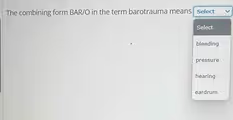
The correct answer is pressure.
The combining form BAR/O originates from the ancient Greek word báros, which translates to “weight” or “pressure.” In medical and scientific terminology, this prefix is consistently used to denote concepts related to pressure.
The term provided, barotrauma, serves as an excellent example to understand this meaning. It can be deconstructed into two parts: “baro,” meaning pressure, and “trauma,” meaning physical injury. Therefore, barotrauma literally translates to “pressure injury.” This condition describes tissue damage caused by a significant difference in pressure between a gas filled space inside the body and the surrounding environment. A common instance is ear barotrauma, which can occur during air travel or scuba diving when the Eustachian tube fails to equalize pressure between the middle ear and the outside atmosphere, leading to pain, hearing loss, or even a ruptured eardrum. Another serious form is pulmonary barotrauma, a risk for divers who ascend too quickly or for patients on mechanical ventilators, where expanding air can damage lung tissue.
To further clarify, let’s consider the other options. The combining form for “bleeding” is typically hem/o or hemat/o, as seen in words like hemorrhage. “Hearing” is represented by audi/o, found in terms like audiology. The “eardrum” is referred to by the combining forms myring/o or tympano/o, as in myringotomy or tympanoplasty.
Understanding that BAR/O relates to pressure is essential for interpreting numerous technical terms. For instance, a barometer is an instrument that measures atmospheric pressure, and baroreceptors are sensors in the body that detect changes in blood pressure. Thus, BAR/O is a fundamental component for vocabulary related to pressure.