The Correct Answer and Explanation is:
Here are the correct answers for the problem:
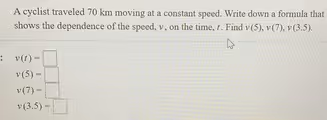
v(t) = 70/t
v(5) = 14
v(7) = 10
v(3.5) = 20
Explanation:
This problem requires understanding the fundamental relationship between distance, speed, and time. The formula that connects these three variables is:
Distance = Speed × Time
In this scenario, we are given:
- Distance (d): A constant 70 km.
- Speed (v): The variable we need to express as a function of time.
- Time (t): The variable on which the speed depends.
1. Deriving the Formula for v(t)
To find the formula that shows the dependence of speed (v) on time (t), we start with the basic equation and substitute the known distance:
70 = v × t
Our goal is to isolate the speed (v) on one side of the equation to define it as a function of time, written as v(t). To do this, we divide both sides of the equation by time (t):
v = 70 / t
Therefore, the formula for the speed as a function of time is:
v(t) = 70/t
This formula shows that speed and time are inversely proportional. To cover a fixed distance, if the travel time increases, the required speed decreases, and if the travel time decreases, the required speed must be higher.
2. Calculating the Specific Values
Now, we use the derived formula v(t) = 70/t to find the speed for the given time values.
- Find v(5):
We substitute t = 5 into the formula:
v(5) = 70 / 5 = 14
This means if the cyclist takes 5 hours, their constant speed must be 14 km/h. - Find v(7):
We substitute t = 7 into the formula:
v(7) = 70 / 7 = 10
If the trip takes 7 hours, the cyclist’s speed must be 10 km/h. - Find v(3.5):
We substitute t = 3.5 into the formula:
v(3.5) = 70 / 3.5 = 20
If the cyclist completes the journey in just 3.5 hours, their speed must be 20 km/h.