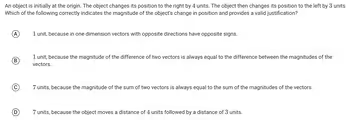
The Correct Answer and Explanation is:
The correct answer is A.
Here is a detailed explanation:
The question asks for the magnitude of the object’s total change in position, which is another term for net displacement. Displacement is a vector quantity, meaning it has both a magnitude (size) and a direction.
First, we need to determine the object’s net displacement. We can model this one-dimensional movement along a number line, with the origin at 0. Let’s define movement to the right as the positive direction and movement to the left as the negative direction.
- First movement: The object moves from the origin to the right by 4 units. This is a displacement vector of +4 units. The object’s position is now at +4.
- Second movement: From its current position, the object moves to the left by 3 units. This is a displacement vector of -3 units.
The total change in position (net displacement) is the vector sum of these two individual displacements.
Net Displacement = (First Displacement) + (Second Displacement)
Net Displacement = (+4 units) + (-3 units)
Net Displacement = +1 unit
The final position of the object is 1 unit to the right of the origin. The question asks for the magnitude of this change in position. The magnitude is the absolute value of the displacement, which is a positive scalar quantity.
Magnitude = |+1 unit| = 1 unit.
Now let’s evaluate the justifications for the answer choices:
- A) 1 unit, because in one dimension vectors with opposite directions have opposite signs. This is correct. We calculated the net displacement to be 1 unit. The justification is the exact principle we used: we assigned a positive sign to the movement to the right and a negative sign to the movement to the left and then added them. This is the correct way to handle vector addition in one dimension.
- B) 1 unit, because the magnitude of the difference of two vectors is always equal to the difference between the magnitudes of the vectors. The numerical answer is correct, but the justification is mathematically false.
- C) 7 units, because the magnitude of the sum of two vectors is always equal to the sum of the magnitudes of the vectors. This is incorrect. The value of 7 units represents the total distance traveled (4 + 3 = 7), not the displacement. The justification is also false; the magnitude of a sum of vectors equals the sum of their magnitudes only when the vectors point in the same direction.
- D) 7 units, because the object moves a distance of 4 units followed by a distance of 3 units. This correctly calculates the total distance traveled but confuses distance with displacement. Displacement is the net change from start to finish, not the total path length.