The Correct Answer and Explanation is:
The correct sentence that uses parallel structure is:
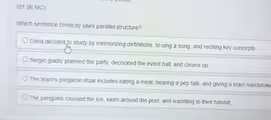
The team’s pregame ritual includes eating a meal, hearing a pep talk, and giving a team handshake.
Explanation
Parallel structure, also known as parallelism, is a fundamental principle of grammar that involves using the same pattern of words to show that two or more ideas have the same level of importance. This technique adds clarity, rhythm, and balance to writing. In a series of items, each element must be in the same grammatical form, such as all nouns, all infinitives (to + verb), or all gerunds (verb + ing).
The chosen sentence correctly applies this principle. It lists three activities that are part of the team’s ritual: “eating a meal,” “hearing a pep talk,” and “giving a team handshake.” Each of these three elements is a gerund phrase, meaning it begins with a verb ending in “ing” that functions as a noun. The consistent structure of “verb-ing + object” makes the sentence flow smoothly and logically.
Let’s examine why the other options are incorrect.
The first sentence, “Diana decided to study by memorizing definitions, to sing a song, and reciting key concepts,” mixes a gerund (“memorizing”), an infinitive (“to sing”), and another gerund (“reciting”). A corrected version would be: “by memorizing definitions, singing a song, and reciting key concepts.”
The second sentence, “Sergio gladly planned the party, decorated the event hall, and cleans up,” fails because of inconsistent verb tense. It uses two past tense verbs (“planned,” “decorated”) and one present tense verb (“cleans”). To be parallel, it should read: “Sergio gladly planned the party, decorated the event hall, and cleaned up.”
The fourth sentence, “The penguins crossed the ice, swam around the pool, and waddling to their habitat,” is also incorrect. It combines two past tense verbs (“crossed,” “swam”) with a present participle (“waddling”). The correct parallel form would be: “The penguins crossed the ice, swam around the pool, and waddled to their habitat.”