The Correct Answer and Explanation is:
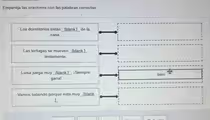
Of course. Based on the Spanish grammar exercise shown in the image, here are the correct matches for each sentence.
Correct Answer
- Los dormitorios están al fondo de la casa. (The bedrooms are at the back of the house.)
- Las tortugas se mueven lentamente. (The turtles move slowly.)
- Laura juega muy bien. ¡Siempre gana! (Laura plays very well. She always wins!)
- Vamos bailando porque estoy muy contento. (Let’s go dancing because I am very happy.)
Explanation
This exercise tests your understanding of different parts of speech, specifically adjectives and adverbs, and how they function within a sentence. The key is to identify what kind of word is needed to logically complete each thought.
For the first sentence, “Los dormitorios están ___ de la casa,” the verb “están” is used to indicate location. The sentence needs a word or phrase that answers the question “¿Dónde?” (Where?). The phrase al fondo (at the back/end) is an adverbial phrase of place that perfectly describes the location of the bedrooms within the house.
In the second sentence, “Las tortugas se mueven ___,” the blank space modifies the verb “se mueven” (they move). It needs an adverb of manner that answers the question “¿Cómo?” (How?). The word lentamente (slowly) is an adverb that describes the manner of movement, and it aligns with the common knowledge about turtles.
The third sentence, “Laura juega muy ___,” also requires an adverb of manner to describe the verb “juega” (plays). The correct word is bien (well). It is an adverb that describes how Laura plays. The context clue, “¡Siempre gana!” (She always wins!), strongly supports this choice. It is important to distinguish this from the adjective “buena,” which would describe a person or thing, not an action.
Finally, the fourth sentence, “Vamos bailando porque estoy muy ___,” uses the verb “estoy,” a form of “estar.” This verb is often followed by an adjective to describe a temporary state or feeling. The word contento (happy/content) is an adjective that describes the speaker’s emotional state, explaining why they want to go dancing. The adjective must agree with the subject (“yo”), so “contento” is used here.