The Correct Answer and Explanation is:
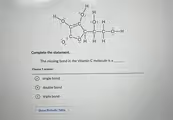
The correct answer is a double bond.
This conclusion is based on the fundamental principles of chemical bonding, particularly the valency of carbon. Carbon atoms are most stable when they form four covalent bonds, allowing them to complete their outer electron shell with eight electrons, a state known as a stable octet.
If we analyze the provided structure of the vitamin C molecule, specifically its anionic form called ascorbate, we can count the bonds on the two carbon atoms where the bond is missing. The carbon atom on the left side of the gap is currently shown with two single bonds: one to an oxygen atom carrying a negative charge and one to the adjacent carbon atom of the carbonyl group. To reach the required four bonds, it needs two more. Similarly, the carbon atom on the right side of the gap is also shown with two single bonds: one to a hydroxyl group (OH) and one to the neighboring carbon in the ring. This atom also needs two additional bonds to become stable.
A single bond placed in the gap would leave both carbons with only three bonds, making them electron deficient and highly unstable. A triple bond would result in each carbon having five bonds, which is a violation of the octet rule and not possible for carbon. Therefore, the only logical and structurally sound option is to place a double bond between these two carbon atoms. This arrangement allows each carbon to form a total of four bonds, satisfying their valency and achieving a stable electron configuration.
This double bond is a critical feature of Vitamin C’s structure. It creates a system known as an enediol, where two hydroxyl groups are attached to the carbons of a double bond. This enediol system is responsible for Vitamin C’s potent antioxidant properties and its acidity, as the resulting anion is stabilized by resonance, with the negative charge and the double bond being delocalized across the oxygen-carbon-carbon-oxygen framework.