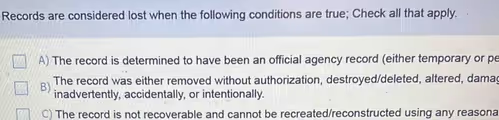
The Correct Answer and Explanation is:
The correct answer is A, B, and C.
For a record to be officially classified as “lost” within a formal records management framework, a specific set of cumulative conditions must be met. These three options represent a comprehensive definition, and all must be true for the designation to apply.
First, option A establishes the necessary foundation. The item must be an “official agency record,” whether its disposition is temporary or permanent. This is a critical starting point because the formal procedures and legal implications associated with lost records only apply to official documents. The loss of personal notes, draft documents not yet declared as records, or other non-record materials would not be handled in the same way. This condition ensures that the focus remains on information that has official value to the organization.
Second, option B describes the event that leads to the record’s unavailability. The record must have been compromised in some manner, such as being removed without authorization, deleted, destroyed, altered, or damaged. This condition clarifies that an action, regardless of intent, has occurred. It is important that the definition includes accidental and inadvertent acts as well as intentional ones. The key element is that the record is no longer in its correct state or location due to a specific incident.
Finally, option C introduces the crucial element of permanence. The record must be truly unrecoverable and impossible to recreate or reconstruct through any reasonable effort. If a deleted file can be restored from a backup, a damaged document can be repaired, or an accurate copy exists elsewhere, the record is not considered permanently lost. This distinguishes a temporary problem from an irreversible loss of information, which is what triggers formal reporting and mitigation actions. Together, these three criteria provide a complete and logical test for determining when a record is officially lost.