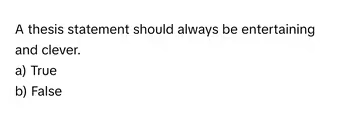
The Correct Answer and Explanation is:
The correct answer is b) False.
A thesis statement’s primary function is to present a clear, specific, and arguable claim, not necessarily to be entertaining or clever. While a witty or engaging thesis can sometimes be effective, especially in persuasive or narrative essays, this is a stylistic choice rather than a fundamental requirement. The most crucial qualities of a strong thesis are clarity and precision.
The main purpose of a thesis is to serve as a roadmap for the reader, outlining the central argument and the direction the paper will take. It must be debatable, meaning it presents a perspective that someone could reasonably challenge. It also needs to be specific enough to be thoroughly supported with evidence and analysis within the confines of the essay. Prioritizing cleverness over these essential functions can lead to a confusing or weak foundation for your paper. An overly intricate or “entertaining” thesis might obscure the main point, leaving the reader unsure of the essay’s purpose.
Furthermore, the word “always” in the statement makes it incorrect. The appropriate tone for a thesis statement heavily depends on the context and audience. In formal academic writing, such as a scientific report, a historical analysis, or a literary critique, a straightforward, scholarly, and direct thesis is the standard. In these contexts, attempting to be clever could be seen as unprofessional or could detract from the seriousness of the argument. Therefore, while a thesis statement should be well-crafted and strong, its core mission is to be an arguable, focused, and clear assertion, not to provide entertainment.