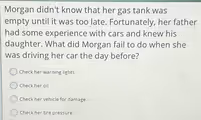
The Correct Answer and Explanation is:
The correct answer is: Check her warning lights.
The explanation for this choice is rooted in the standard functionality of modern automobiles. Vehicles are equipped with an instrument cluster on the dashboard that includes numerous warning lights. These lights serve as the car’s primary communication system to alert the driver of immediate needs or potential malfunctions. One of the most common and important of these is the low fuel warning light.
This specific indicator, often an icon of a gas pump, illuminates when the fuel level drops into the reserve capacity. This is not an emergency signal for an immediate shutdown but rather a proactive warning. It is designed to give the driver ample notice, typically providing a range of 30 to 50 miles, to find a gas station. The question states that Morgan ran out of gas, implying she was unaware of the low fuel level “the day before.” Had she performed a basic check of her dashboard and its warning lights, she would have seen the illuminated low fuel symbol. This observation would have prompted her to refuel, preventing the situation she ultimately faced.
The other options are incorrect because they relate to different vehicle systems. Checking her oil is crucial for engine health and lubrication, and a different light warns of low oil pressure. Checking for vehicle damage is a safety inspection, usually performed after a collision or if unusual noises are heard. Finally, checking tire pressure relates to safety, handling, and fuel economy, and it is monitored by a separate Tire Pressure Monitoring System (TPMS) light. Morgan’s specific problem was a lack of fuel, a condition directly and clearly indicated by the low fuel warning light. Her failure was one of observation.