The Correct Answer and Explanation is:
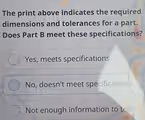
Based on the visual evidence provided, the correct answer is Not enough information to tell.
The question asks for a judgment on whether “Part B” conforms to specifications detailed on a “print above”. To answer this definitively, a comparison between two sets of information is necessary. First, we need the specifications themselves, which would be on the engineering print. This print would detail the nominal dimensions, such as length, diameter, or hole position, along with the allowed tolerances. Tolerances define the acceptable range of variation for each dimension, often expressed as a plus or minus value (e.g., 10.00 ± 0.05 mm).
Second, we would need the actual, measured dimensions of the specific item in question, which is “Part B”. An inspector would use measurement tools like calipers or a coordinate measuring machine to determine the real characteristics of Part B.
The image provided contains neither of these essential pieces of data. We cannot see the “print above” that contains the required specifications, nor are we given any measurement report or data for Part B. Without knowing the target dimensions and their acceptable ranges, and without knowing the actual measured size of the part, it is impossible to perform the necessary comparison.
Choosing “Yes, meets specifications” or “No, doesn’t meet specifications” would be a random guess. The only factually correct conclusion that can be drawn from the incomplete information is that a determination cannot be made. This is a common scenario in quality control and technical assessment where missing data prevents a valid conclusion. Therefore, the only logical and responsible answer is that there is not enough information to tell.