The Correct Answer and Explanation is:
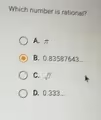
The correct answer is D. 0.333…
A rational number is defined as any number that can be expressed as a fraction, or ratio, of two integers (p/q), where the denominator (q) is not zero. The decimal representation of a rational number will either terminate, meaning it ends, or it will repeat in a predictable pattern forever.
Let’s analyze each option based on this definition:
- A. π (pi): Pi is a famous irrational number. Its decimal representation (3.14159…) continues infinitely without ever repeating a pattern. Therefore, it cannot be written as a simple fraction and is not rational.
- B. 0.83587643…: The ellipsis (…) indicates that the decimal continues. However, there is no discernible repeating pattern in the digits shown. In mathematics problems of this type, a number presented this way is intended to represent a non-terminating, non-repeating decimal, which is the definition of an irrational number.
- C. √7 (the square root of 7): The square root of any integer that is not a perfect square is an irrational number. Since 7 is not a perfect square (like 4 or 9), its square root results in a decimal that goes on forever with no repeating pattern (approximately 2.64575…). Thus, it is irrational.
- D. 0.333…: This number is a repeating decimal. The digit ‘3’ repeats infinitely, as indicated by the ellipsis. All repeating decimals are rational because they can be converted into a fraction. The number 0.333… is the decimal representation of the fraction 1/3. Since it can be expressed as a ratio of two integers (1 and 3), it perfectly fits the definition of a rational number.