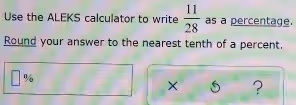
The Correct Answer and Explanation is:
Correct Answer: 39.3
Explanation
The process to convert the fraction 11/28 into a percentage and round it to the nearest tenth involves three main steps: converting the fraction to a decimal, converting the decimal to a percentage, and then rounding the percentage to the specified precision.
First, to convert the fraction 11/28 into a decimal, you must divide the numerator (11) by the denominator (28). A fraction is essentially a division problem. Performing this division gives you a decimal value.
11 ÷ 28 = 0.39285714…
This result is a repeating decimal, but we only need the first few decimal places to perform the next steps accurately.
Second, you need to convert this decimal into a percentage. The word “percent” literally means “per hundred,” so to express a number as a percentage, you multiply it by 100. A simple way to do this is to move the decimal point two places to the right.
0.39285714… × 100 = 39.285714…%
Now we have the value as a percentage, but the problem requires a specific format for the final answer.
Third, you must round the answer to the nearest tenth of a percent. The tenths place is the first digit immediately following the decimal point. In the number 39.285714…%, the digit in the tenths place is 2.
To round correctly, we look at the digit directly to the right of the tenths place, which is the hundredths place. In this case, the digit in the hundredths place is 8. The standard rule for rounding is that if this digit is 5 or greater, we round up the digit in the tenths place. If it is 4 or less, we keep the tenths digit as it is.
Since 8 is greater than 5, we must round up the digit in the tenths place. This means the 2 becomes a 3. All the digits after the new tenths digit are dropped.
Therefore, 39.285714…% rounded to the nearest tenth of a percent is 39.3%.