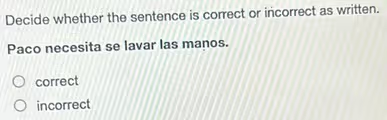
The Correct Answer and Explanation is:
The correct answer is incorrect.
The sentence “Paco necesita se lavar las manos” is grammatically incorrect due to the placement of the reflexive pronoun “se”. In Spanish, when a verb construction involves a conjugated verb followed by an infinitive, as in “necesita lavar”, the reflexive pronoun has two possible correct positions, but floating between the two verbs is not one of them.
The first and most common correct way to write this sentence is to attach the pronoun to the end of the infinitive. The verb “lavar” (to wash) and the pronoun “se” (himself) combine to create the reflexive infinitive “lavarse”. The sentence would be: “Paco necesita lavarse las manos.” This structure is clear and is the standard way to express this idea, meaning “Paco needs to wash his hands.”
The second grammatically correct option is to place the reflexive pronoun before the entire conjugated verb phrase. In this case, “se” would come before “necesita”. The sentence would then read: “Paco se necesita lavar las manos.” Although this is a valid construction, it is often considered less common or natural in everyday speech compared to attaching the pronoun to the infinitive.
The original sentence, “Paco necesita se lavar las manos,” makes the error of isolating the pronoun “se” between the conjugated verb and the infinitive. In Spanish, pronouns in these types of verb phrases cannot stand alone in the middle; they must either be attached to the infinitive (or a gerund) or precede the conjugated verb. Because the pronoun is not in a valid position, the sentence as written is incorrect.