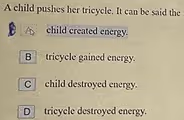
The Correct Answer and Explanation is:
The correct answer is B: tricycle gained energy.
This scenario is a classic example of energy transfer and the principle of work. In physics, energy is the capacity to do work. The entire interaction is governed by the Law of Conservation of Energy, which states that energy cannot be created or destroyed, only converted from one form to another or transferred from one object to another.
Let’s break down the options. Options A and C, which suggest the child either created or destroyed energy, are incorrect. The child does not create energy from nothing. Instead, the child’s body converts chemical potential energy, stored from the food they have eaten, into mechanical energy to push the tricycle. The child expends or uses their stored energy, but they do not destroy it. Similarly, options C and D are incorrect because energy is not destroyed in this process.
The most accurate description is that the tricycle gained energy. Before the child pushes it, the tricycle is at rest and has zero kinetic energy, which is the energy of motion. When the child applies a force and moves the tricycle over a distance, they are doing work on the tricycle. This work transfers energy from the child to the tricycle. The tricycle begins to move, meaning it now possesses kinetic energy. Because its kinetic energy increased from zero to a positive value, the tricycle has gained energy.
In summary, the child acts as an energy source, converting their internal chemical energy to perform work. This work results in a direct transfer of energy to the tricycle, causing it to move and thereby gain kinetic energy. Therefore, the statement “tricycle gained energy” correctly describes the outcome of the child’s push.