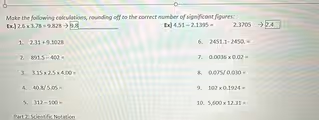
The Correct Answer and Explanation is:
Based on the rules of significant figures, the correct answer to the calculation is 2.37.
The answer provided in the image’s example box, 2.4, appears to be incorrect due to a likely typographical error on the worksheet. Here is a detailed explanation of how to arrive at the correct answer.
The rule for determining significant figures in addition or subtraction is based on precision, specifically the number of decimal places. The final answer must be rounded to the same number of decimal places as the measurement with the fewest decimal places. This is different from the rule for multiplication and division, which depends on the total count of significant figures.
Let’s break down the problem: 4.51 – 2.1395.
- Analyze the Precision: First, we examine the number of decimal places in each value.
- 4.51 has two decimal places. Its last significant digit is in the hundredths place.
- 2.1395 has four decimal places. Its last significant digit is in the ten-thousandths place.
- Identify the Limiting Term: The number with the fewest decimal places is 4.51. This value is the least precise and therefore limits the precision of our final answer. The answer must be rounded to two decimal places (the hundredths place).
- Perform the Calculation: Next, we perform the subtraction as written.
- 4.51 – 2.1395 = 2.3705
- Round to the Correct Decimal Place: Now, we round the result, 2.3705, to two decimal places as determined in step 2. To do this, we look at the third decimal digit, which is 0. The rule for rounding states that if the digit to be dropped is less than 5, we do not change the preceding digit. Since 0 is less than 5, the second decimal digit, 7, remains the same.
Therefore, the correctly rounded answer is 2.37. The answer 2.4 would only be correct if we were rounding to one decimal place, which would imply that one of the starting numbers had only one decimal place (for instance, 4.5), which is not the case in this problem.