The Correct Answer and Explanation is:
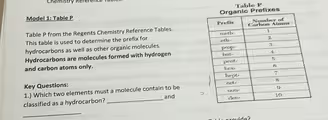
The correct answer is hydrogen and carbon.
A molecule must contain only hydrogen and carbon atoms to be classified as a hydrocarbon. This answer is explicitly stated in the provided text from the worksheet. The passage located under “Model 1: Table P” defines hydrocarbons as “molecules formed with hydrogen and carbon atoms only.” This clear and direct definition serves as the source for the answer.
The name “hydrocarbon” itself is a significant clue, as it is a compound word formed from the names of its constituent elements. The “hydro” prefix refers to hydrogen, while the second part, “carbon,” refers to the element carbon. This simple nomenclature directly reflects the molecule’s exclusive composition, making the definition intuitive and easy to remember.
Hydrocarbons are the foundational building blocks of all organic chemistry. This is due to the unique chemical properties of the carbon atom. Carbon can form four strong, stable covalent bonds, which allows it to link with other carbon atoms to create long chains, branched structures, and complex rings. These carbon structures form a molecular “skeleton.” Hydrogen atoms, which form one bond each, then attach to the available sites on the carbon skeleton, completing the molecule and resulting in a vast array of stable compounds.
Examples of hydrocarbons are abundant and essential to modern life. Methane (CH4) is the simplest hydrocarbon and is the primary component of natural gas. Ethane (C2H6) and propane (C3H8) are other common examples. These substances are the basis for fossil fuels like petroleum and natural gas, which we refine into gasoline, diesel, and heating oil.
It is important to recognize the strictness of this definition. While countless organic compounds contain hydrogen and carbon, they are only considered hydrocarbons if those are the only two elements present. If other elements like oxygen, nitrogen, or a halogen are included, the molecule belongs to a different class of compounds, such as alcohols, amines, or alkyl halides. Therefore, the exclusive presence of hydrogen and carbon is the definitive characteristic of a hydrocarbon.