The Correct Answer and Explanation is:
Here are the correct answers and a detailed explanation for the problems shown in the image.
Correct Answers
- The coordinate of point J is -3.
- The component form of vector CD is <4, -6>.
- The magnitude of vector CD is 2√13, and its direction is approximately 303.7 degrees or -56.3 degrees.
Explanation
This worksheet covers fundamental concepts in coordinate geometry and vector analysis. Let’s review each problem to find the correct solutions.
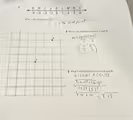
For the first question, we determine the coordinate of point J by reading its position on the given number line. The number line is marked with integers. Point O is at the origin, 0. Counting to the left into the negative numbers, we see that point J is located precisely on the mark for -3. Therefore, the coordinate of J is -3.
The second question asks for the component form of the vector CD. A vector’s component form, written as <x, y>, describes its horizontal and vertical change. To find this, we first identify the coordinates of points C and D from the grid. Assuming a standard coordinate system where the grid lines are one unit apart, we can assign coordinates C = (-3, 4) and D = (1, -2). The component form is found by subtracting the initial point’s coordinates (C) from the terminal point’s coordinates (D). The horizontal component is 1 minus (-3), which equals 4. The vertical component is -2 minus 4, which equals -6. Thus, the component form of vector CD is <4, -6>. This indicates a movement of 4 units to the right and 6 units down.
The third question requires finding the magnitude and direction of vector CD. The magnitude is the length of the vector, calculated using the Pythagorean theorem with its components. The magnitude is the square root of (4 squared plus (-6) squared), which is the square root of (16 + 36), or √52. This simplifies to 2√13, which is approximately 7.21. The direction is the angle the vector makes with the positive x-axis. We use the arctangent of the vertical component divided by the horizontal component: arctan(-6/4) or arctan(-1.5). This gives an angle of approximately -56.3 degrees. Since the vector <4, -6> is in the fourth quadrant, this angle is correct. It can also be expressed as a positive angle of 360 – 56.3 = 303.7 degrees.