The correct answer and explanation is:
The correct answer is C.
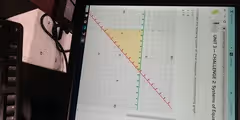
The question requires identifying which of the given points is a solution to the system of inequalities represented on the graph. The solution set for a system of inequalities is the common shaded region, which is the yellow triangular area in this case. A point is considered a solution if it lies within this shaded region. To verify this mathematically, we must first determine the inequalities that define the boundaries of the region.
The yellow area is bounded by three lines:
- A red dashed line with a negative slope. This line passes through the y-intercept at (0, 10) and the x-intercept at (10, 0). The equation for this line is y = -x + 10. Since the line is dashed, the points on the line are not part of the solution. The shading is below the line, so the corresponding inequality is y < -x + 10.
- A green dashed vertical line. This line is located at x = 2. The shaded region is to the right of this line, which indicates values of x that are greater than 2. As the line is dashed, the inequality is strict: x > 2.
- The x-axis (where y = 0). The shaded region is above the x-axis, meaning all y-values in the solution set must be positive. This gives us the third inequality: y > 0.
Now, we test the coordinates of Point C (4, 1) against this system of three inequalities:
- Is x > 2? Substituting x = 4, we get 4 > 2, which is true.
- Is y > 0? Substituting y = 1, we get 1 > 0, which is true.
- Is y < -x + 10? Substituting x = 4 and y = 1, we get 1 < -4 + 10, which simplifies to 1 < 6. This is also true.
Since Point C (4, 1) satisfies all three conditions, it is a solution to the system. Other points like B (8, 4) and D (1, 5) are not solutions because they fail to meet all the conditions.