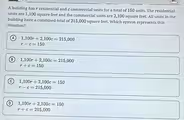
The correct answer and explanation is:
The correct option is the second one, which presents the following system of equations:
1,100r + 2,100c = 215,000
r + c = 150
Here is a detailed explanation of how to arrive at this answer.
The problem requires creating two distinct equations based on the two different totals provided: the total number of units and the total square footage.
First, let’s establish the equation for the total number of units. The problem states there are r residential units and c commercial units. The building has a total of 150 units. Therefore, the sum of the residential units and the commercial units must equal 150. This relationship is represented by the simple addition equation:
r + c = 150
Next, we need to create an equation for the total square footage. The problem gives the size of each type of unit. Each residential unit is 1,100 square feet, and each commercial unit is 2,100 square feet. To find the total area contributed by all residential units, we multiply the number of residential units (r) by the size of each one (1,100). This gives us 1,100r. Similarly, the total area for all commercial units is the number of commercial units (c) multiplied by their size (2,100), which gives us 2,100c.
The problem states that the combined total square footage for all units in the building is 215,000 square feet. To represent this, we add the total residential area (1,100r) to the total commercial area (2,100c) and set the sum equal to the overall total area of 215,000. This gives us the second equation:
1,100r + 2,100c = 215,000
When combined, these two equations form a system that accurately models the conditions described in the problem. The other options incorrectly assign the totals, for instance, by setting the area equation equal to the unit count.