The correct answer and explanation is:
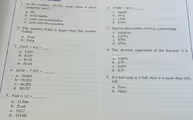
Based on the image provided, the correct answer to question 7, “Express the fraction 14/16 as a percentage,” is c. 87.5%.
Here is a detailed explanation of how to arrive at this answer.
To convert a fraction into a percentage, you follow a clear two-step process: first, convert the fraction to a decimal, and second, convert that decimal into a percentage.
The initial fraction is 14/16. While not strictly necessary, a helpful first action is to simplify the fraction. Simplifying makes subsequent calculations easier by using smaller numbers. Both the numerator (14) and the denominator (16) are even, so they share a common factor of 2. Dividing both parts of the fraction by 2 gives you 7/8. The fraction 7/8 is equivalent in value to 14/16.
Next, you convert the simplified fraction, 7/8, into a decimal. A fraction is fundamentally a division problem, where the numerator is divided by the denominator. So, we need to calculate 7 divided by 8. Performing this division (7 ÷ 8) results in the decimal 0.875. This decimal value is the direct numerical representation of the fraction.
The final step is to convert the decimal 0.875 into a percentage. The word “percent” originates from the Latin term “per centum,” which means “per one hundred.” This tells us that to find the percentage, we must multiply the decimal value by 100. Multiplying 0.875 by 100 gives us 87.5. An easy way to perform this multiplication is to simply move the decimal point two places to the right. After doing this, you add the percent sign (%) to denote the value as a percentage.
Thus, 14/16 simplifies to 7/8, which is 0.875 as a decimal, and finally converts to 87.5%. This confirms that option c is the correct choice. The other options are incorrect; for example, 87% is an imprecise rounding, and the problem has an exact answer.