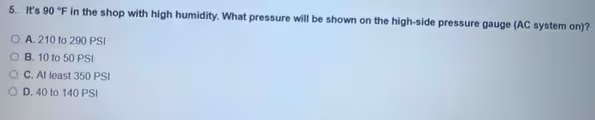
The correct answer is A. 210 to 290 PSI.
The pressure on the high side of an automotive air conditioning system is directly influenced by the ambient temperature and humidity outside the vehicle. The high side of the system, which includes the compressor and the condenser, is responsible for compressing the refrigerant gas and then cooling it back into a liquid state. This cooling process happens in the condenser, which functions like a radiator, transferring heat from the refrigerant to the surrounding air.
When the ambient temperature is high, like the 90°F specified in the question, the temperature difference between the hot refrigerant and the outside air is smaller. This reduced differential makes it more difficult for the condenser to reject heat, causing the pressure and temperature within the high side of the system to rise. High humidity further complicates this process. The condenser must not only cool the air passing through it but also condense water vapor, which consumes a portion of its cooling capacity. This added thermal load from high humidity further reduces the condenser’s efficiency and results in even higher head pressures.
A common rule of thumb for a properly functioning R-134a or R-1234yf system is that the high side pressure should be approximately 2.2 to 2.5 times the ambient temperature in Fahrenheit. At 90°F, this calculation gives a baseline pressure of 198 to 225 PSI. Given the additional load from high humidity, the pressure would be expected to be in the upper part of this range or slightly higher.
Therefore, the range of 210 to 290 PSI is the most realistic for a normally operating system under these hot and humid conditions. Option B (10 to 50 PSI) and D (40 to 140 PSI) describe pressures typically seen on the low side of the system or high-side pressures on a much cooler day. Option C (at least 350 PSI) indicates an excessive pressure, which would suggest a system fault like a clogged condenser, a malfunctioning cooling fan, or a severe overcharge.