The Correct Answer and Explanation is:
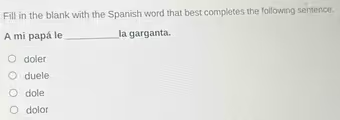
The correct answer is duele.
The complete sentence is: “A mi papá le duele la garganta.” This translates to “My dad’s throat hurts” or, more literally, “To my dad, his throat hurts him.” To understand why “duele” is the correct choice, we need to analyze the grammar of the Spanish verb doler (to hurt, to ache).
The verb doler functions in a way that can be confusing for English speakers because it operates like the verb gustar (to be pleasing to). In this type of sentence structure, the thing that is causing the pain is the grammatical subject of the sentence, and the person experiencing the pain is the indirect object.
In our sentence, “la garganta” (the throat) is the thing causing the pain, so it is the subject. Because “la garganta” is a singular noun, the verb doler must be conjugated in the third-person singular form to agree with it.
The verb doler is also a stem-changing verb, where the ‘o’ in the stem changes to ‘ue’ in most present-tense conjugations. The third-person singular present tense conjugation of doler is “duele”.
Let’s look at the other options:
- doler is the infinitive form of the verb. A sentence requires a conjugated verb, so this is incorrect.
- dole is not a correct conjugation of this verb in Spanish.
- dolor is a noun that means “pain” or “ache.” While related, a noun cannot function as the verb in this sentence. You could form a different sentence, “Mi papá tiene dolor de garganta” (My dad has throat pain), but that uses the verb tener (to have), not doler.
Therefore, “duele” is the only option that is correctly conjugated to match the singular subject “la garganta,” fitting the grammatical structure required by the verb doler.