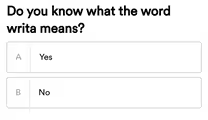
The Correct Answer and Explanation is:
The correct answer to the question in the image is A: Yes.
The word “writa” is a form of the Old English verb wrītan, which is the direct ancestor of our modern English word “write.” The meaning of wrītan is fascinating because it reveals the physical origins of writing itself. Initially, the word did not mean to form letters with ink on parchment, but rather “to score, to carve, or to scratch.” This original meaning points to the earliest forms of Germanic writing, such as carving runes into hard surfaces like wood, stone, or metal. This act of incising or scratching lines into a surface was the fundamental concept of “writing” for early Anglo Saxons.
Over time, as writing technologies and practices evolved, the meaning of wrītan broadened. With the introduction of Christianity to England came the widespread use of Latin script, vellum, parchment, and ink. The verb wrītan adapted to encompass this new method of forming letters and composing texts. It began to signify the act of setting down words in a manuscript, much closer to our contemporary understanding. This linguistic journey is shared with other Germanic languages. For example, the related Old Norse word ríta also meant “to scratch or write,” and the modern German word reißen means “to tear or rip,” still retaining a sense of physically marking or breaking a surface.
Therefore, “writa” is not just an archaic spelling but a historical artifact. It provides a window into a time when writing was a fundamentally different physical process. The word’s evolution from “to carve” to “to compose with a pen” beautifully mirrors the technological and cultural development of communication in the English speaking world.