The Correct Answer and Explanation is:
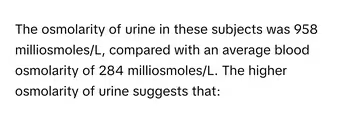
The higher osmolarity of urine suggests that the kidney is reabsorbing water.
Explanation:
Osmolarity is a measure of the concentration of dissolved solutes in a fluid. The provided text indicates that the subjects’ urine has an osmolarity of 958 milliosmoles per liter, which is significantly higher than their average blood osmolarity of 284 milliosmoles per liter. This means the urine is hyperosmotic, or more concentrated, relative to the blood.
This concentration process occurs within the kidneys, which are responsible for filtering waste from the blood and regulating the body’s water and electrolyte balance. The process begins in the glomerulus, where blood is filtered to create a fluid called filtrate. This initial filtrate has an osmolarity very similar to that of blood plasma, around 284 mOsm/L in this case.
As this filtrate travels through the intricate system of tubules in the nephron, particularly the loop of Henle and the collecting ducts, the kidneys selectively modify its composition. For the final urine to become more concentrated than the initial filtrate, water must be removed from the tubules and returned to the bloodstream. This process is known as water reabsorption.
The ability to create concentrated urine is a crucial mechanism for water conservation. Under the influence of hormones like antidiuretic hormone (ADH), the collecting ducts become more permeable to water. This allows water to move via osmosis from the filtrate back into the highly concentrated interstitial fluid of the renal medulla and then into the blood. Consequently, solutes are left behind in the remaining fluid, dramatically increasing the concentration of the urine that is ultimately excreted. Therefore, the high urine osmolarity is direct evidence that substantial water reabsorption has occurred, allowing the body to eliminate waste products while conserving vital water.