The Correct Answer and Explanation is:
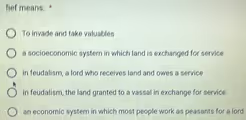
The correct answer is the fourth option: in feudalism, the land granted to a vassal in exchange for service.
A fief was a central element of feudalism, the dominant social, economic, and political system in medieval Europe. It refers specifically to an estate of land held on conditional terms. A powerful nobleman or a monarch, known as a lord, would grant a fief to a subordinate, who was called a vassal. This grant was not an outright gift of ownership but rather a form of land tenure.
In exchange for the use of the fief and the income it generated from the labor of the peasants who lived on it, the vassal had several obligations to the lord. The most important of these was military service. The vassal pledged to fight for the lord and often had to provide a certain number of knights for the lord’s army for a set number of days per year. The vassal also swore an oath of fealty, a solemn promise of loyalty and allegiance, and was expected to provide the lord with counsel and financial aid on certain occasions. This entire arrangement was formalized in a ceremony of homage and investiture.
The other options are incorrect for specific reasons. The term for a socioeconomic system in which land is exchanged for service is feudalism itself, not a fief. A lord is the one who grants land, while the vassal is the one who receives it and owes service, making the third option factually wrong. An economic system where peasants work for a lord is known as manorialism or the seignorial system, which was the economic foundation of the fief but not the fief itself. Lastly, invading and taking valuables describes raiding, a practice entirely different from the structured, contractual relationship that the granting of a fief represented.