The Correct Answer and Explanation is:
The correct value that goes in the box is 4.
The problem presented is an example of simplifying an expression using the quotient rule of exponents. This rule is a fundamental shortcut in algebra for dividing two powers that share the same base. The rule states that when you divide two exponential terms with an identical base, you can find the result by keeping the base the same and subtracting the exponent of the denominator from the exponent of the numerator.
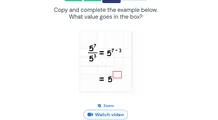
Let’s break down the specific example provided: (5^7) / (5^3).
In this expression, the number 5 is the base, and it is the same for both the term in the numerator (top part) and the term in the denominator (bottom part). The exponent in the numerator is 7, and the exponent in the denominator is 3.
According to the quotient rule, we keep the base, which is 5, and subtract the exponents. The calculation for the new exponent is the top exponent minus the bottom exponent, which is 7 minus 3.
The image correctly sets up this step: 5^(7 – 3).
To find the value that goes inside the box, we simply perform the subtraction:
7 – 3 = 4.
This result, 4, becomes the new exponent for the base 5. Therefore, the simplified expression is 5^4. The box in the final step represents this new, simplified exponent.
To understand why this rule works, you can visualize the expression in its expanded form. 5^7 is (5 * 5 * 5 * 5 * 5 * 5 * 5) and 5^3 is (5 * 5 * 5). When you divide them, you can cancel out three pairs of 5s from the top and bottom, leaving four 5s, or 5^4, in the numerator. The rule of subtracting exponents is a much faster way to arrive at the same answer.