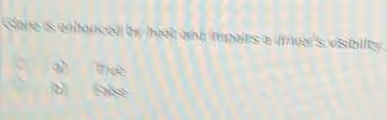
The Correct Answer and Explanation is:
Correct Answer: True
The statement presented in the image is, “Glare is enhanced by haze and impairs a driver’s visibility.” This is true for several scientific and practical reasons.
First, let’s understand the components. Glare is the difficulty of seeing in the presence of bright light, such as direct sunlight or the headlights of an oncoming vehicle. It occurs when the intensity of light is much greater than the ambient light the eyes are adapted to. Haze is an atmospheric condition caused by fine particles like dust, smoke, and pollutants suspended in the air.
The statement’s first claim is that haze enhances glare. This is correct because the fine particles in haze scatter sunlight. Instead of light traveling in a straight line from the sun to the observer’s eye, it hits these particles and is redirected in multiple directions. This process creates a diffuse, uniform sheet of bright light across the field of vision. This widespread, scattered light reduces contrast and makes it much more difficult for the eyes to distinguish objects from their background, thereby intensifying the effects of glare.
The second part of the statement, that glare impairs a driver’s visibility, is a fundamental principle of driving safety. When a driver experiences glare, their ability to perceive hazards is significantly reduced. The intense light can be blinding, causing the pupils to constrict drastically and making it hard to see darker areas of the road, such as the road surface, pedestrians in the shade, or other vehicles. This visual impairment can lead to delayed reaction times and a decreased ability to judge distances and speeds accurately.
Therefore, because haze scatters light to create a more intense and diffuse glare, and this glare severely compromises a driver’s ability to see the road clearly and react to potential dangers, the entire statement is true.