The Correct Answer and Explanation is:
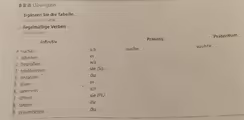
Here is the correctly completed table from the exercise.
| Infinitiv | Pronomen | Präsens | Präteritum |
| 0. machen | ich | mache | machte |
| 1. arbeiten | er | arbeitet | arbeitete |
| 2. begrüßen | wir | begrüßen | begrüßten |
| 3. telefonieren | sie (Sg.) | telefoniert | telefonierte |
| 4. tanzen | du | tanzt | tanztest |
| 5. üben | er | übt | übte |
| 6. sammeln | ihr | sammelt | sammeltet |
| 7. öffnen | sie (Pl.) | öffnen | öffneten |
| 8. spülen | wir | spülen | spülten |
| 9. plaudern | du | plauderst | plaudertest |
Explanation of German Regular Verbs
This exercise focuses on conjugating German regular verbs, also known as “schwache Verben” or weak verbs, in two essential tenses: the present tense (Präsens) and the simple past tense (Präteritum). The conjugation of these verbs follows a highly predictable and consistent pattern, which is a cornerstone of German grammar.
Present Tense (Präsens) Conjugation
To conjugate a regular verb in the present tense, you begin with the verb’s stem, which is found by removing the infinitive ending, typically “-en” (e.g., the stem of machen is mach). You then attach the appropriate personal ending corresponding to the subject pronoun. The standard endings are:
- ich: -e (ich mache)
- du: -st (du plauderst)
- er/sie/es: -t (er übt)
- wir: -en (wir begrüßen)
- ihr: -t (ihr sammelt)
- sie/Sie: -en (sie öffnen)
Certain verb stems require a minor spelling adjustment for pronunciation. If a stem ends in -t or -d, like arbeiten or plaudern, an extra -e- is inserted before the endings -st and -t. This is why the correct forms are er arbeitet and du plauderst. If a stem ends in -s, -ß, or -z, like tanzen, the du form takes only a -t ending instead of -st, resulting in du tanzt.
Simple Past Tense (Präteritum) Conjugation
The simple past tense of regular verbs is also formed systematically. To the verb stem, you add a -t- suffix, followed by the specific Präteritum personal endings. The pattern is: verb stem + t + ending. The endings are:
- ich: -e (ich machte)
- du: -est (du tanztest)
- er/sie/es: -e (er arbeitete)
- wir: -en (wir spülten)
- ihr: -et (ihr sammeltet)
- sie/Sie: -en (sie öffneten)
The same pronunciation rule for stems ending in -t or -d applies here. An extra -e- is added before the -t- suffix to make the word easier to say, as seen in er arbeitete and du plaudertest.