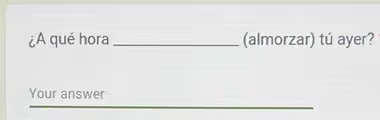
The Correct Answer and Explanation is:
The correct answer is almorzaste.
Explanation
The correct answer to complete the sentence “¿A qué hora ________ (almorzar) tú ayer?” is almorzaste. This requires understanding Spanish verb conjugation, specifically in the preterite tense.
First, we must identify the necessary verb tense. The word ayer, meaning “yesterday,” is a key indicator. It signals a specific, completed action that took place in the past. In Spanish, the tense used for such actions is the preterite tense (pretérito indefinido). This tense is used for events that have a clear beginning and end in the past.
Next, we need to conjugate the verb almorzar (to have lunch) according to the subject of the sentence. The subject is tú, which is the informal singular “you.”
The verb “almorzar” is an “-ar” verb. The standard preterite endings for regular “-ar” verbs are:
- yo: -é
- tú: -aste
- él/ella/usted: -ó
- nosotros/as: -amos
- vosotros/as: -asteis
- ellos/ellas/ustedes: -aron
For the subject “tú,” the correct ending is -aste. We take the stem of the verb, “almorz-,” and add this ending to get almorzaste.
It is important to note that while “almorzar” is a stem-changing verb in the present tense (o -> ue, as in “yo almuerzo”), it does not have a stem change in the preterite tense. It does have a spelling change in the “yo” form (yo almorcé) to preserve the ‘s’ sound, but this does not affect the “tú” form.
Therefore, combining these elements, the full, grammatically correct sentence is: ¿A qué hora almorzaste tú ayer?, which translates to “At what time did you have lunch yesterday?”