The Correct Answer and Explanation is:
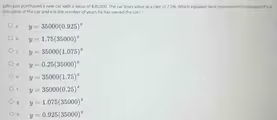
The correct answer is a. y = 35000(0.925)^x
This problem describes a situation of exponential decay, where an initial value decreases by a fixed percentage over regular time intervals. The general formula for exponential growth or decay is y = a(1 ± r)^x.
Let’s break down the components of this formula in the context of the question:
- y represents the final value of the car after a certain amount of time.
- a is the initial value or starting amount. In this case, the car was purchased for $35,000, so a = 35,000.
- r is the rate of change per time period, expressed as a decimal. The problem states the car “loses value,” which indicates decay or a decrease. The rate is 7.5%. To use this in the formula, we must convert the percentage to a decimal by dividing by 100: r = 7.5 / 100 = 0.075.
- x represents the number of time periods that have passed. Here, x is the number of years John has owned the car.
Since the car’s value is decreasing, we use the subtraction form of the general formula: y = a(1 – r)^x.
Now, we can substitute the known values into this formula:
- Start with the decay formula: y = a(1 – r)^x
- Substitute the initial value for ‘a’: y = 35000(1 – r)^x
- Substitute the decay rate for ‘r’: y = 35000(1 – 0.075)^x
- Calculate the value inside the parentheses, which is known as the decay factor: 1 – 0.075 = 0.925. This factor means that each year, the car retains 92.5% of its value from the previous year.
- The final equation is: y = 35000(0.925)^x.
This equation accurately models the car’s value, y, starting at $35,000 and decreasing by 7.5% each year for x years. Comparing our result to the given options, it perfectly matches option a. Option c, with a factor of (1.075), would incorrectly represent an annual increase in value, or appreciation. Other options either misuse the initial value and rate or use an incorrect decay factor.