The Correct Answer and Explanation is:
Of course. Here are the correct answers to the questions on the worksheet, along with a detailed explanation for each.
Correct Answers and Explanations
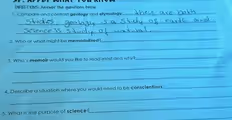
1. Compare and contrast geology and etymology.
Answer: Both geology and etymology are specific fields of academic study. The main difference between them lies in their subject matter. Geology is the scientific study of the Earth, including its physical structure, materials, history, and the processes that act upon it. Geologists study rocks, minerals, fossils, and landforms to understand how our planet was formed and continues to change.
In contrast, etymology is the study of the origin of words and how their forms and meanings have evolved over time. Etymology is a branch of linguistics, not a natural science. For example, an etymologist might trace the word “disaster” back to its Greek roots, “dis” (bad) and “aster” (star), revealing an old belief that calamities were caused by the unfavorable alignment of celestial bodies. So, while both are systematic studies, geology focuses on the physical Earth and etymology focuses on the history of language.
2. Who or what might be memorialized?
Answer: To memorialize something is to create a lasting tribute to preserve its memory. Both people and events can be memorialized. A person who might be memorialized is often someone who made a significant contribution to society, such as a national hero, a president, a civil rights leader, or a soldier who died in service. An event that might be memorialized is usually one of great historical importance or emotional impact, like a major war, a nation’s independence, or a tragic event that a community wants to remember and learn from.
3. Whose memoir would you like to read most and why?
Answer: This question requires a personal opinion, but a strong answer must demonstrate an understanding of what a memoir is. A memoir is a nonfiction account written by a person about a specific period or experience in their own life. Unlike a full autobiography, it focuses on a particular memory or theme. A good answer would name a specific person and explain the reason for the choice. For example: “I would like to read the memoir of Marie Curie to understand not just her scientific breakthroughs but also the personal challenges she faced as a woman in a male-dominated field during the early 20th century.”
4. Describe a situation where you would need to be conscientious.
Answer: To be conscientious means to be extremely careful, diligent, and thorough in your duties. A situation that requires conscientiousness is one where precision and attention to detail are critical to ensure a positive and safe outcome. For example, a pharmacist filling a prescription must be incredibly conscientious. They need to carefully read the doctor’s order, select the correct medication, measure the exact dosage, and ensure the label has the right instructions. A small mistake could cause serious harm to a patient, so their work demands a profound sense of duty and meticulous care.
5. What is the purpose of science?
Answer: The fundamental purpose of science is to gain knowledge and understanding of the natural and social world through a systematic methodology based on observation and experimentation. Science aims to explain how and why things happen, create testable models and theories to describe reality, and use this understanding to make accurate predictions about future events. Ultimately, this knowledge can be applied to solve practical problems, develop new technologies, improve human health, and inform public policy, driving progress and enhancing our collective quality of life.