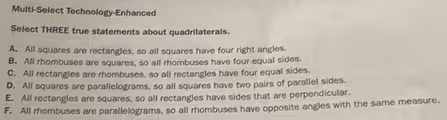
The Correct Answer and Explanation is:
The correct answers are A, D, and F.
Here is an explanation of why these statements are true and the others are false.
Correct Statements
- A. All squares are rectangles, so all squares have four right angles. This statement is true. The definition of a rectangle is a quadrilateral with four right angles. A square, by its definition, has four right angles and four equal sides. Since a square meets the requirement of having four right angles, every square is a special type of rectangle. The conclusion that all squares have four right angles is a correct property derived from this relationship.
- D. All squares are parallelograms, so all squares have two pairs of parallel sides. This statement is true. A parallelogram is a quadrilateral with two pairs of parallel opposite sides. A square has two pairs of opposite sides that are parallel, so it fits the definition of a parallelogram. The conclusion that all squares have two pairs of parallel sides is a core property of parallelograms that applies to squares.
- F. All rhombuses are parallelograms, so all rhombuses have opposite angles with the same measure. This statement is also true. A rhombus is a quadrilateral with four equal sides. A property of rhombuses is that their opposite sides are parallel, which makes every rhombus a parallelogram. A key property of all parallelograms is that their opposite angles are equal. Therefore, this property correctly applies to all rhombuses.
Incorrect Statements
- B. All rhombuses are squares, so all rhombuses have four equal sides. This is false because the initial premise, “All rhombuses are squares,” is incorrect. While both shapes have four equal sides, a square must also have four right angles. A rhombus without right angles is not a square.
- C. All rectangles are rhombuses, so all rectangles have four equal sides. This is false. The premise “All rectangles are rhombuses” is incorrect. A rectangle has four right angles but does not need to have four equal sides. A rhombus must have four equal sides. A rectangle is only a rhombus if it is also a square.
- E. All rectangles are squares, so all rectangles have sides that are perpendicular. This is false. The premise “All rectangles are squares” is incorrect. All squares are rectangles, but not all rectangles are squares. A rectangle only becomes a square if its four sides are equal in length.