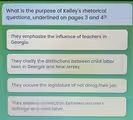
The Correct Answer and Explanation is:
Based on the provided image and the context of Florence Kelley’s famous 1905 speech on child labor, the correct answer is the fourth option.
Correct Answer: They make a connection between women’s suffrage and child labor.
Explanation
Florence Kelley’s 1905 address is a masterful piece of rhetoric that strategically intertwines two major social justice movements of her era: the abolition of child labor and the fight for women’s suffrage. The purpose of her rhetorical questions is central to this strategy.
Kelley begins her speech by presenting a grim, detailed account of the horrific conditions faced by young children working in factories and mills across the United States. She uses emotional and vivid imagery to build a sense of moral outrage in her audience. After establishing the severity of the problem, she pivots to its political cause and potential solution using powerful rhetorical questions.
A key question she poses is, “If the mothers and the teachers in Georgia could vote, would the Georgia Legislature have refused at every session for the last three years to stop the work in the mills of children under twelve years of age?” This question is not meant to be answered literally. Instead, it forces her audience to arrive at the conclusion she intends. She implies that the male-dominated legislatures are indifferent to the suffering of children because the primary caregivers, women, are politically powerless. By denying women the vote, the system silences the most passionate advocates for children’s welfare.
Therefore, the questions serve to forge an undeniable link between the two issues. Kelley argues that ending the injustice of child labor is not possible without first achieving the justice of women’s suffrage. The vote, in her argument, is not just a right for women but a necessary tool to protect the nation’s most vulnerable. The other options are less accurate; while she implicitly accuses the legislature and clarifies laws, the primary rhetorical function of her questions is to build this crucial bridge between enfranchising women and saving children.