The Correct Answer and Explanation is:
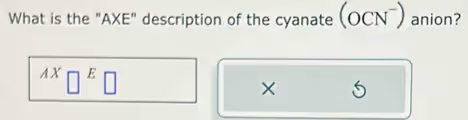
The correct AXE description for the cyanate anion (OCN⁻) is AX₂E₀.
Explanation
The AXE method, also known as VSEPR theory, helps predict the geometry of a molecule based on its Lewis structure. In this notation:
- A represents the central atom.
- X represents the number of atoms bonded to the central atom.
- E represents the number of lone pairs of electrons on the central atom.
To determine the AXE description for the cyanate anion (OCN⁻), we follow these steps:
- Identify the Central Atom (A): In the OCN⁻ ion, carbon (C) is the least electronegative atom, so it serves as the central atom.
- Draw the Lewis Structure: We first count the total valence electrons: Carbon (4) + Nitrogen (5) + Oxygen (6) + 1 (for the negative charge) = 16 valence electrons. The most stable Lewis structure for cyanate has the central carbon atom forming double bonds with both the oxygen and nitrogen atoms, or a single bond with oxygen and a triple bond with nitrogen. In all valid resonance structures, the octet rule is satisfied for all atoms. The most common representation is [O=C=N]⁻.
- Determine X and E:
- X (Bonded Atoms): Looking at the central carbon atom, it is bonded to two other atoms: one oxygen atom and one nitrogen atom. Therefore, the value for X is 2. Note that for VSEPR theory, double and triple bonds are treated as a single electron domain.
- E (Lone Pairs): In the Lewis structure of cyanate, the central carbon atom uses all its valence electrons to form bonds with oxygen and nitrogen. There are no lone pairs of electrons directly on the central carbon atom. Therefore, the value for E is 0.
Combining these components gives the final AXE description of AX₂E₀. This corresponds to a linear electron geometry and a linear molecular shape with a bond angle of 180°.