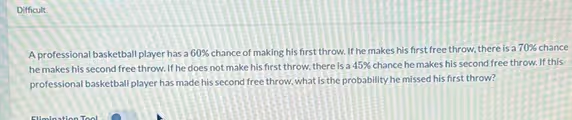
The Correct Answer and Explanation is:
The correct answer is 0.3 or 30%.
This is a conditional probability problem that can be solved using Bayes’ theorem. The goal is to find the probability that the player missed the first free throw, given that we know he made the second one.
First, let’s identify the probabilities given in the problem:
- The probability of making the first throw is 60%, or 0.60.
- The probability of missing the first throw is therefore 1 – 0.60 = 0.40.
- The probability of making the second throw if the first was made is 70%, or 0.70.
- The probability of making the second throw if the first was missed is 45%, or 0.45.
Next, we need to calculate the overall probability that the player makes his second free throw. This can happen in two distinct scenarios:
- He makes the first throw AND makes the second throw. The probability of this is the chance of making the first (0.60) multiplied by the chance of making the second after the first was made (0.70).
Calculation: 0.60 * 0.70 = 0.42. - He misses the first throw AND makes the second throw. The probability of this is the chance of missing the first (0.40) multiplied by the chance of making the second after the first was missed (0.45).
Calculation: 0.40 * 0.45 = 0.18.
The total probability of making the second free throw is the sum of the probabilities of these two scenarios:
Total Probability = 0.42 + 0.18 = 0.60.
Finally, we can find the probability that he missed his first throw given that he made his second. We divide the probability of the specific scenario we are interested in (missing the first and making the second) by the total probability of making the second.
Probability = (Probability of missing the first and making the second) / (Total probability of making the second)
Probability = 0.18 / 0.60 = 0.3.
So, there is a 0.3, or 30%, chance that the player missed his first throw given he made the second.